
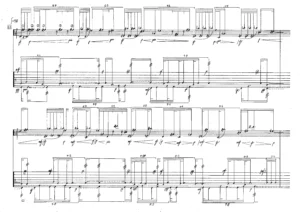
Echancree (notched), for soprano saxophone and percussionist, was written over two years. In its present format it is a work in 10 sections. These sections are not movements; the only pauses between them are short and for emphasising the apparent change of musical material, and clarifying the changes of texture. Such divisions, however, become increasingly indistinct as the piece proceeds. The percussionist’s instrumentarium is entirely made up from un-pitched instruments though within some sections the timbral differences have been treated similarly to pitch. Eventually, in the final version to be premiered in Hobart this (2026) December, the work will have 12 sections.
The sections of the work function in different ways and possess a cyclic relationship in which material presented becomes enriched, though through this process looses its singular identity; that is, in the opening cycle [2.1-2.3] the material is rich in symbolic power with direct and incisive gesture; in the second cycle [3.1-3.3] the material is increasingly expressive though consequently softer in contour; and by the third cycle [4.1-4.3] the material has a high degree of similarity across sections and is couched in hollow gestures of weakened expressive power.
The central inspiration for the piece was the ritualistic and mantic context in which proto-writing and then early true writing systems developed. The earliest inscribed records contain symbols for which the act of incising the graphs or glyphs themselves into their base material (bone, turtle plastra, wood, rock) was more important than the graphs or glyphs themselves. Great pits have been found with collections of ox scapulae and turtle plastra, fully inscribed, suggesting both a near proto-industrial scale of production and that archiving these bodies as documents was not important. Future eyes would not read them. Divination and mantic practices, too, increasingly became rationalised in early states (Shang Dynasty China, pre-Republican Rome) and absorbed into the bureaucratic apparatus of governance; from cultic origins where prognostication had real impact on life to symbolic action that became a focal point of state power, and a mechanism for the delivery of edicts. These processes, in which human activity and communication are increasingly ordered and made functional, are essential to communal life. There is, just as there was around the time of the industrial revolutions, a fundamental change in existence; an immediate (ie, without mediation) period and then a mediated period. We cannot, naturally, assume to understand an un-mediated period existence however much we may speculate on it. Echancree is perhaps such a speculation on these processes.
There is a wooden tablet of Pacific Rosewood removed to the Louvre from Easter Island that is inscribed with glyphs common to the proto-writing system originating there, Rongorongo. The object has a large notch cut into it suggesting that it was repurposed by a later generation of the same culture, by then illiterate in the hieratic text and consequently disregarding the taboo nature of the tablet. The tablet is primarily designated ‘D’, and secondarily as ‘RR3’. It has become known at the museum as ‘echancree’.
– David William Murray